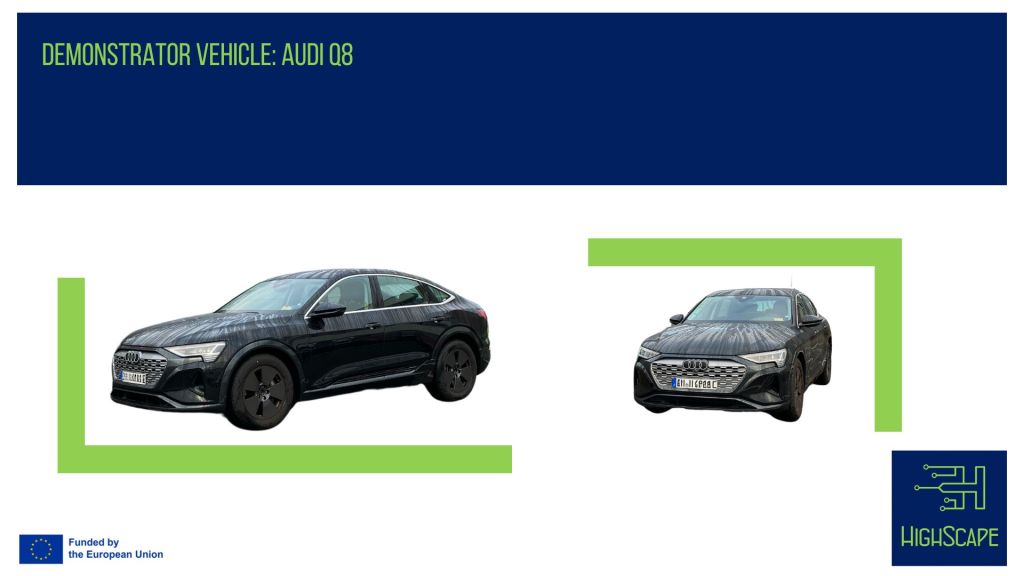
Demonstrating solutions: AUDI Q8

As we have started the 3rd year of our project, we are dedicated to demonstrate the components developed in realistic environments. One of these is the AUDI vehicle demonstrator, an AUDI Q8, integrating the latest technologies available on the market. 

This is an essential step towards evaluation and future exploitation of project results and we are looking forward to all activities in the coming year. 

LeMesurier KPI assessment

LeMesurier is building a framework to track 2ZERO’s impact on sustainable road transport research and innovation. It measures KPI achievement and partnership’s projects impact while recommending improved evaluation methods.

We are pleased to have contributed to the LeMesurier KPI assessment as part of the 2ZERO Partnership.

This is also a step for us to measure our project’s contribution to driving 🌱 cleaner, more sustainable transport solutions. We are looking forward to further discussions and final results!

New paper: E-gear functionality based on mechanical relays in permanent magnet synchronous machines

Permanent magnet synchronous machines (PMSMs) are still the first choice for use in electric vehicles, due to their unparalleled efficiency and power density. However, they suffer from an inherently limited speed range. As field weakening or the addition of a mechanical gearbox deteriorates the efficiency of the drive, it is suggested in this paper to equip the drive with reconfiguration switches, giving rise to a so-called e-gear. The switches—which are implemented by means of mechanical relays—allow to change the winding connection of the electric machine from a series to a parallel connection and hence to double its efficient speed range.Simulations and experimental results on a 4-kW axial-flux PMSM confirm the feasibility of the concept and prove that the reconfiguration can be conducted in less than 35 ms.

Read the full paper by Hendrik Vansompel, et al. HERE.

Results that count

In HighScape, we are – among others – building on project results generated by the EVC1000 Project; The Electric Vehicle Components for 1000km daily trips.

The aim of this project, that was successfully completed in 2022, was to provide innovative and mass-production optimised components enabling the efficient integration of powertrain and chassis systems, which will increase Electric Vehicles (EV) range and user acceptance. 

It is pleasing to see that the EVC1000 Project, part of E-VOLVE Cluster, has been mentioned  in the latest CORDIS Results Pack. The results of the EVC1000 project provide a solid background for our ongoing activities such as the HighScape and the EM-TECH project, which are developing new efficient technologies for electric drives and their components within HorizonEurope programme.